"I got
calls from people who hadn’t read Superman since they
were 12 and now they were 50. And they were very upset. ‘How
could you do this,’ they’d say. Or ‘I hope
your house burns down.’ "And then you start to
worry about your house burning down," continues
the writer. "We got enough threats where I know both
[editor] Mike Carlin
and I were contacted by a bodyguard service that offered to
protect us. But when you get phone calls and offers like that—you
start to realize how big Superman is as a character."
Realizing how big
a deal a story called "The Death of Superman"
would be to fans, even if Superman would eventually be resurrected,
was something that escaped Jurgens and the other writers working
on the story. But it wasn’t a naivete that stopped the
writers from seeing the huge ramifications a story like this
would bring—it was their total dedication to telling
a story that wouldn’t just set records or get massive
media attention but would simply entertain fans.
"The story’s
a bigger deal in retrospect than it was when we were putting
it together," says Jurgens. "One of the
things we were always accused of is trying to cook up a huge
marketing stunt to get people to read Superman. But that wasn’t
it at all. All the Superman writers and artists got together
and said, ‘What are we going to do for the next year
in Superman?’ And we decided to do ‘The Death
of Superman.’ We came up with this character called
Doomsday and put it all together. And for us, it was a matter
of telling a good story. We thought it could be dramatic—Superman
dies! And then what really interested us was what would happen
to the world with Superman gone—that lead to ‘World
Without Superman’ and some of the other stories that
followed. We just tried to do it the same way we did everything
else—we just sat down for a good story. We wanted to
make it a good, solid, entertaining story."
And then there
was the media hype that followed the story. From Entertainment
Weekly to "Entertainment Tonight"
to local news updates, everyone was covering the biggest story
in the country and that story was how DC
Comics just killed their top star—Superman.
"There
isn’t a word in the English language to describe the
level of surprise we all felt [when we saw the coverage],"
explains Jurgens. "I certainly remember the conversations
at the time and it was, ‘Can you believe this?’
There was no ripple and no buzz [before the story really broke]
though. After the catalogue came out and the media began picking
up on it, the whole deal went nova! We were all flat out stunned
by it."
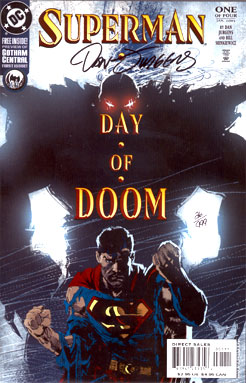
Today, Jurgens
is revisiting Superman and the hero’s death with Day
of Doom, a four-issue, weekly mini-series available now. Following
Ty Duffy, a Daily Planet reporter assigned
to write a retrospective on Superman’s death, Jurgens
says the story is like an extra on a DVD and a companion piece
to "Death of Superman" that will answer
a lot of fans’ problems and complaints about the original
story.
"Ty Duffy
is a reporter for the Daily Planet, who I think represents
the very obvious cynical attitude that we might find out there
right now," says Jurgens. "And frankly,
the kind of attitude I think permeates a lot of comic fandom.
He’s a total cynic. He kind of brings up the points
that a lot of fans have about Superman dying and then coming
back, which are not without merit. So, I think that makes
the story a little more interesting."
And while Jurgens
doesn’t want to give away too much about the series
and what Duffy eventually finds while covering Superman’s
death, he does say he has some very different thoughts about
the story than he did in 1992.